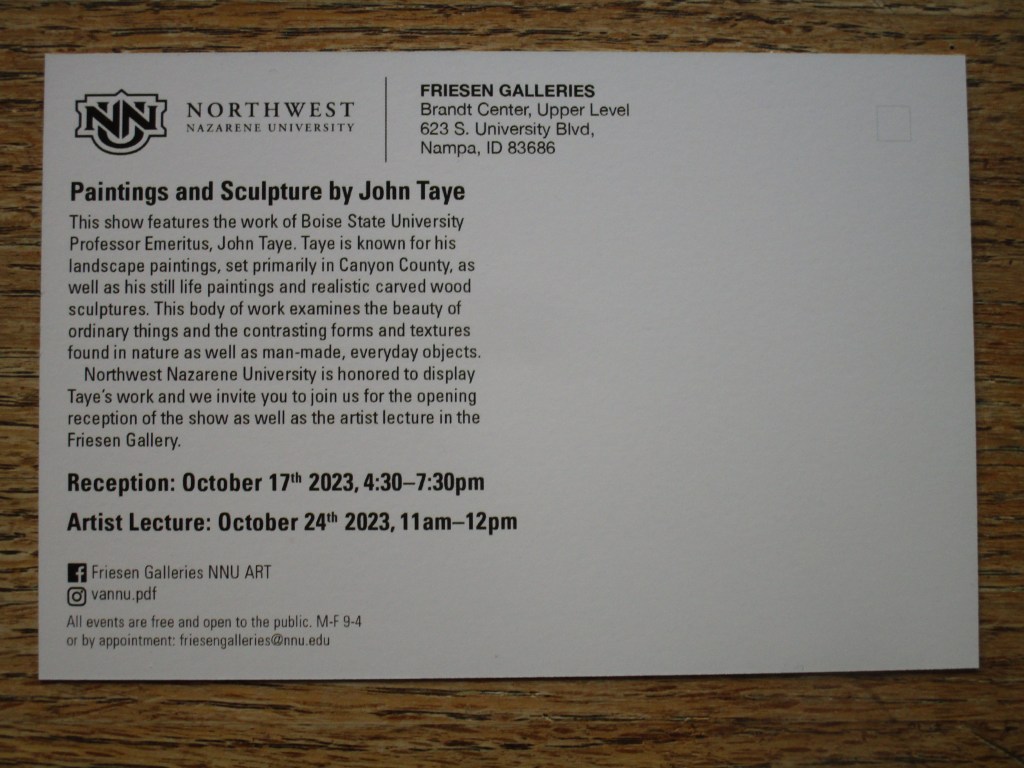
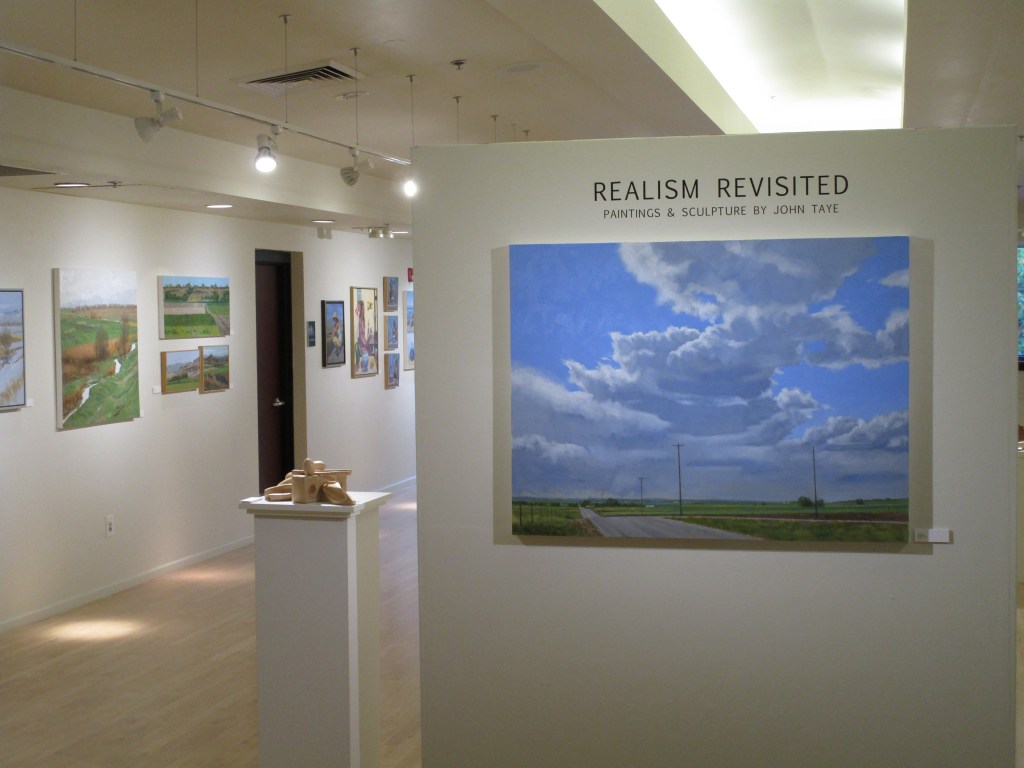
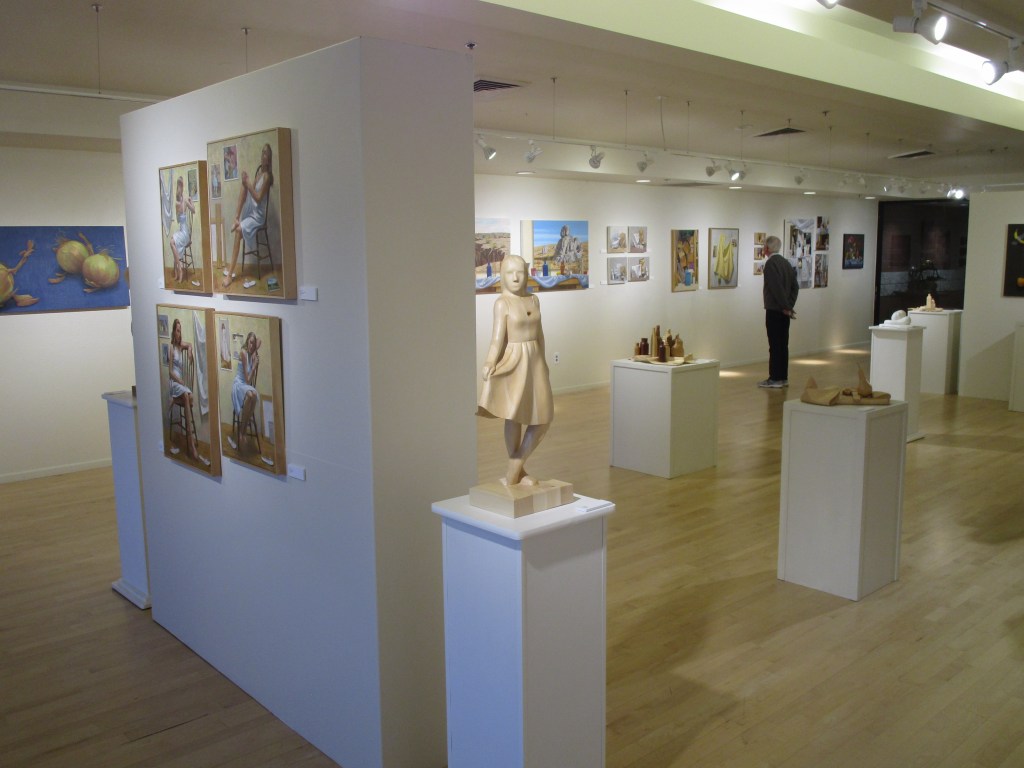
I’m having an exhibit of paintings and sculpture called, “Realism Revisited”, at the Friesen Gallery at Northwest Nazarene University in Nampa, Idaho. Over 50 paintings of landscape, still life and figure subjects are on display, and 10 sculptures in a variety of media. (Details are on the cards shown.) It’s the largest show I have had in over 12 years, and I am quite pleased with the gallery installation. An article in the Boise Weekly the week of October 23 describes the show. I’ve attached a few images of the gallery.
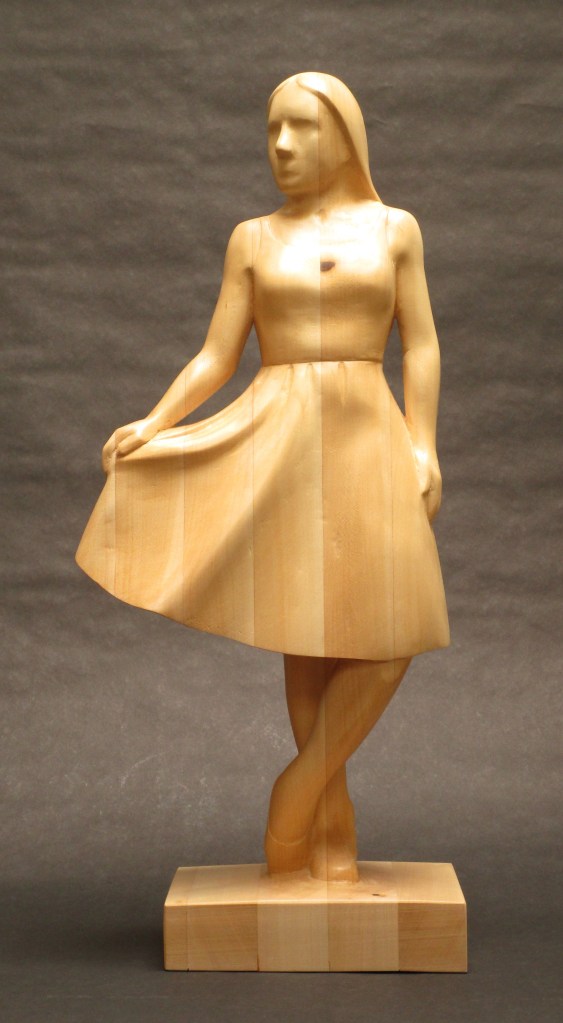
I recently completed a wood sculpture, “Interlude”, carved in basswood, 26″ high. The piece took about 100 hours to do. Viewers may be interested in the process, so I am including a series of photos showing different aspects.
This shows the laminated block of wood, a small half-sized clay sketch, and full size drawings. The drawings were very important as all the critical dimensions were included there.
Most of the early stages of the carving were done with a large, slightly curved gouge and a wooden mallet.
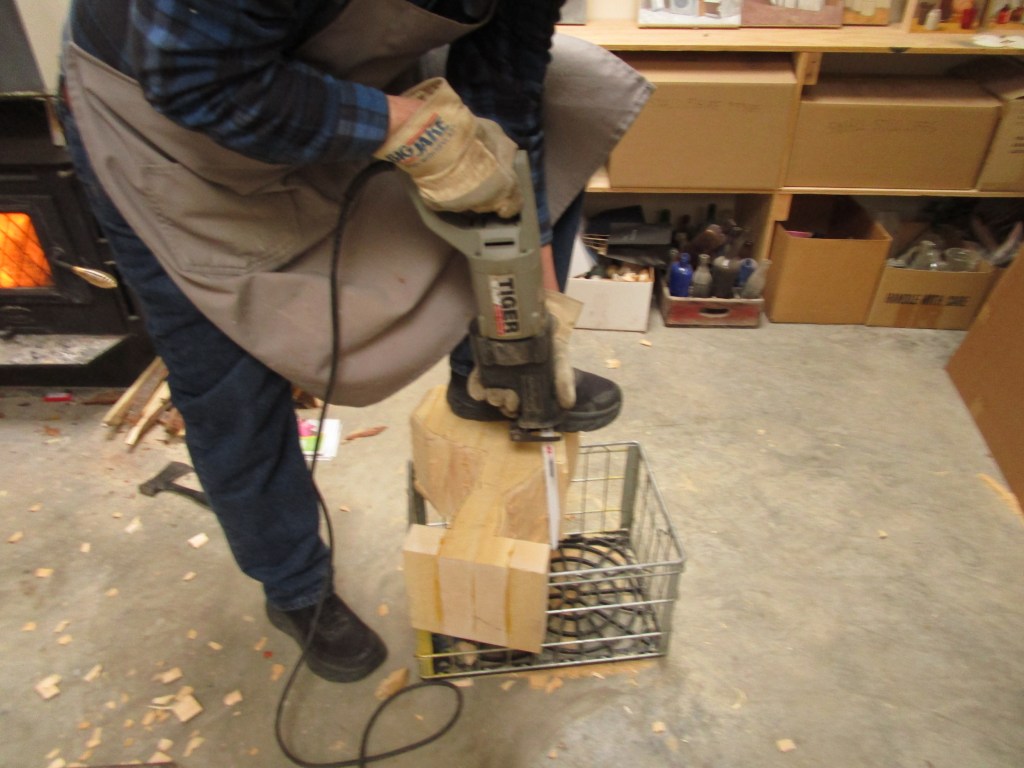
A sawzall was also used to remove as much extra wood as possible.
The front profile has been nearly completed.
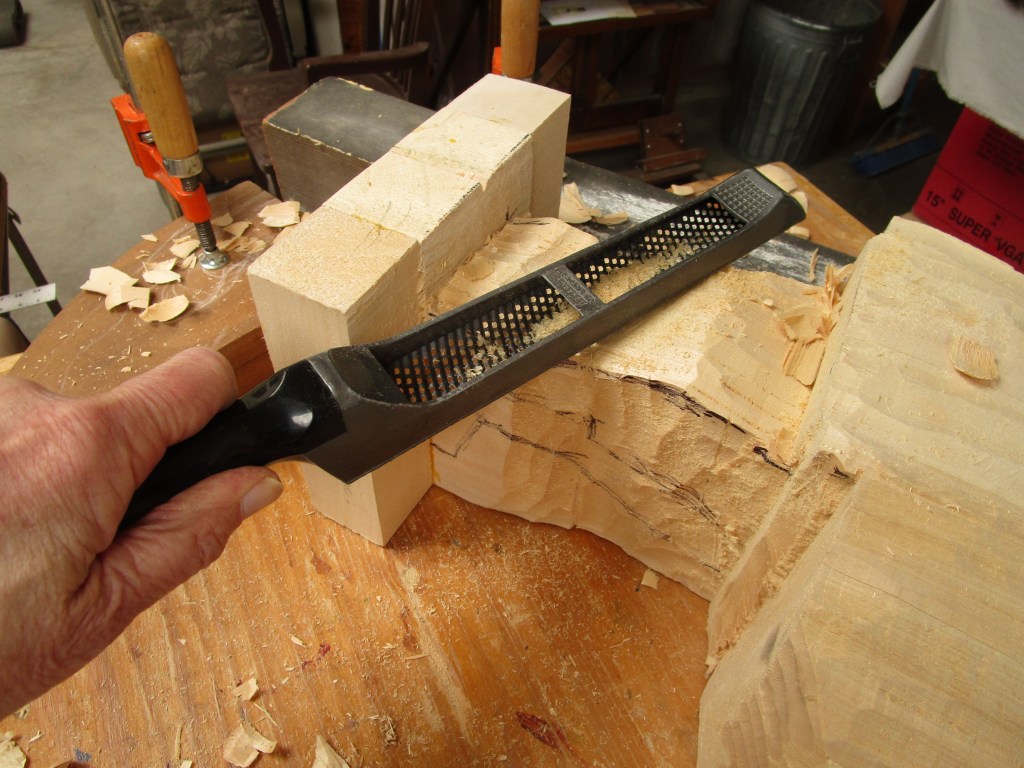
A surform tool, much like a cheese grater, is frequently used to clarify the surface and to remove gouge marks.
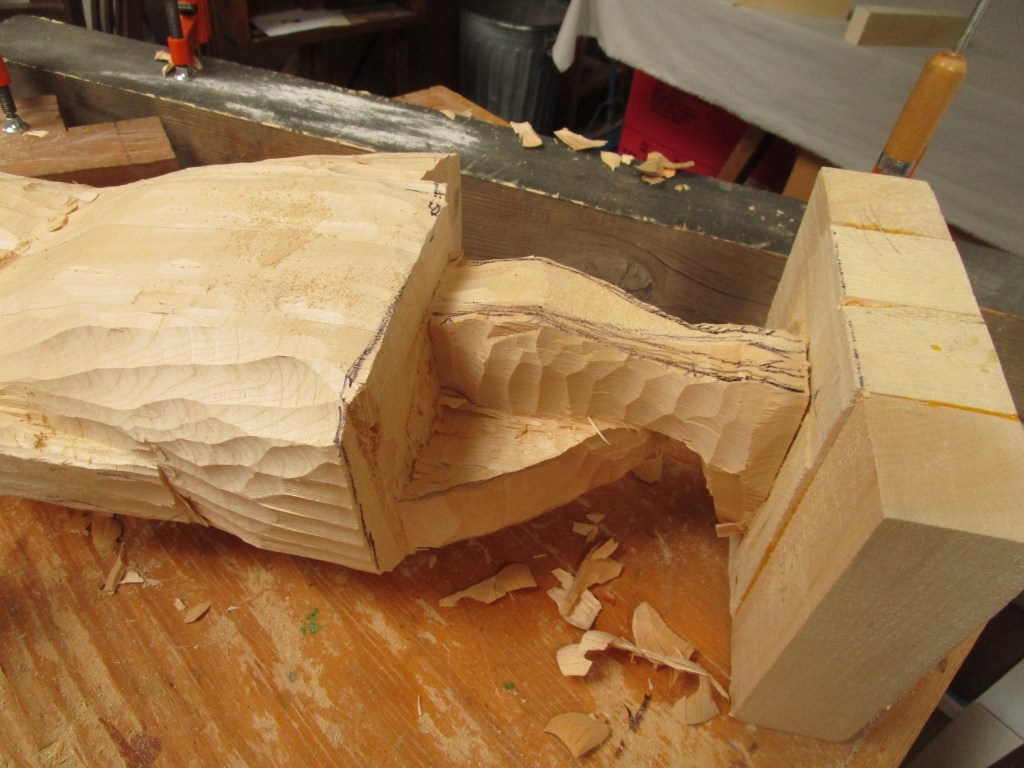
The area around the legs and feet has been roughed out.
Further work on the legs. I draw on the wood frequently with a marker to remind myself what needs to be removed.
The right arm has been partially roughed out. The size of the wood chips on the table indicate about how much is being removed with each cut. This kind of sculpture is a “subtractive” art, and one has to be careful not to take away too much, as it can’t be put back!
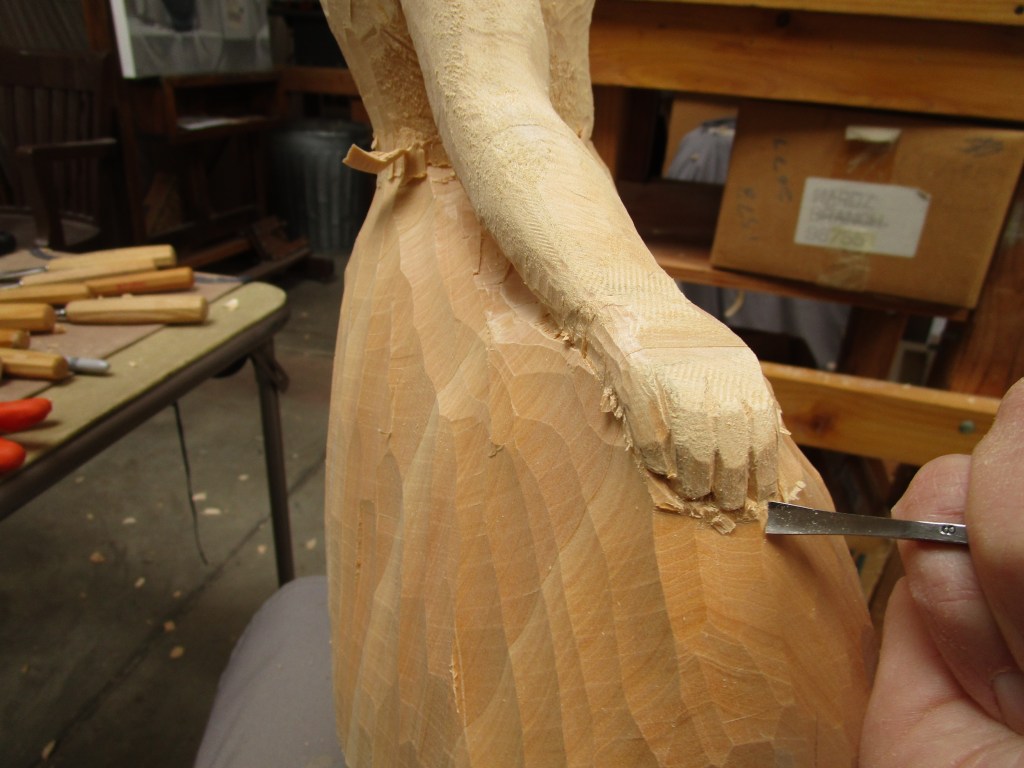
The arm and hand further refined. A small gouge is used a lot at this stage of the carving.
It helps to drill holes in an areas where wood needs to be removed to create openings in the arms and legs.
The dress has been further developed.
Lots of holes help in removing wood under the edge of the dress, so it has the illusion of being fabric.. The edge is later thinned to about 1/8″ thick.
Probably 20% of my time is spent sanding the wood, starting with 80 grit, then 150, 220, and finally 320. The wood is very pale at this point, but when a clear lacquer finish is applied, the warmth and color really appear. The figure has a birthmark on her chest–small knots often show up in a finished piece, nature’s contibution to the artwork.
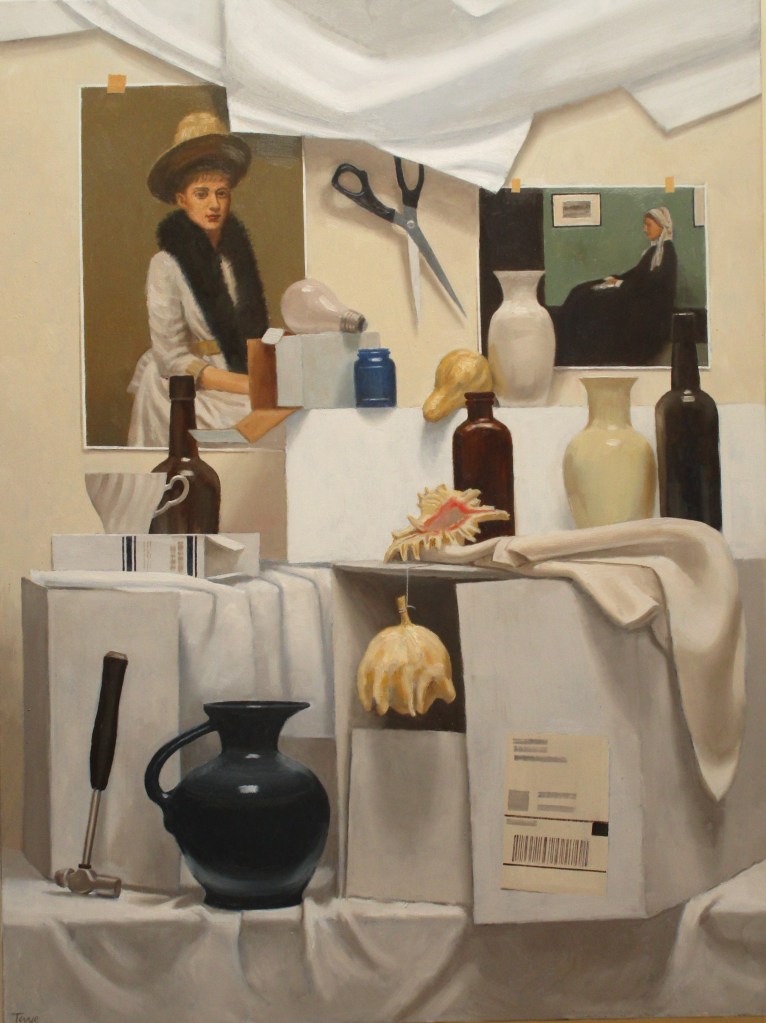
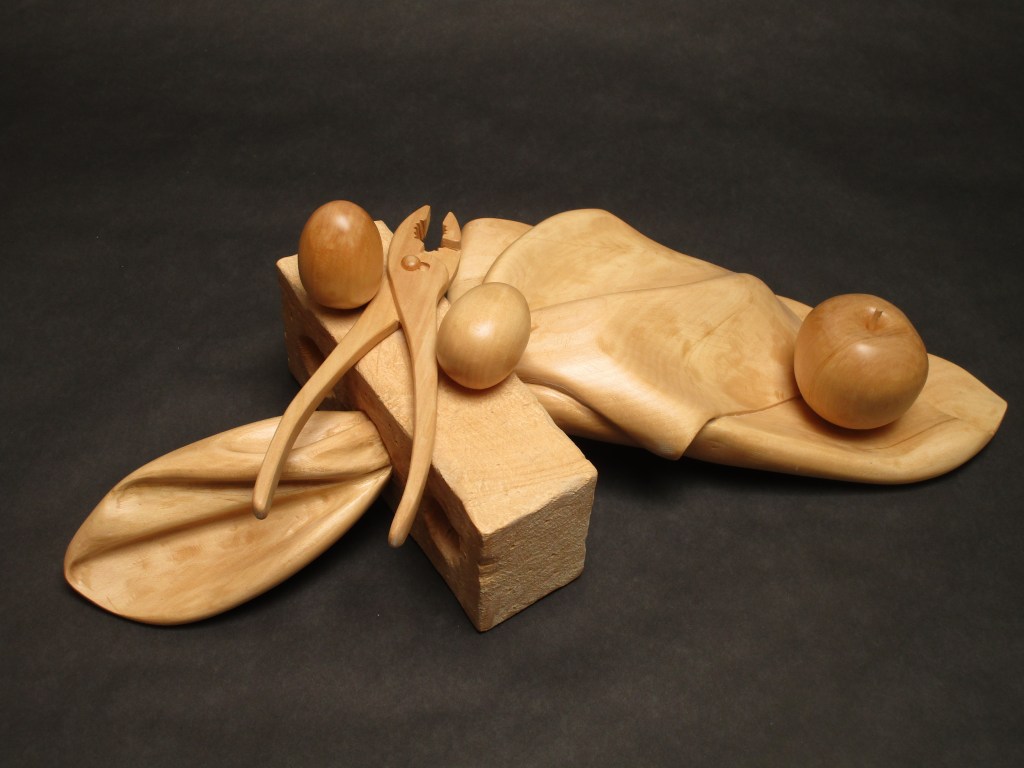
In May, I will be showing 16 new oil paintings and several new wood pieces at the Capitol Contemporary Gallery in Boise. My emphasis this time is on still life subjects. Some of the compositions are fairly complex, like “Arrangement in White and Black”, 30 x 40. Others are simpler studies of fruit and vegetable forms, greatly enlarged. The wood pieces combine natural and man-made objects with contrasting forms and textures, like “Pulled Through”, shown below. The show opens on First Thursday, May 4, 5-8pm, and continues through the month of May.
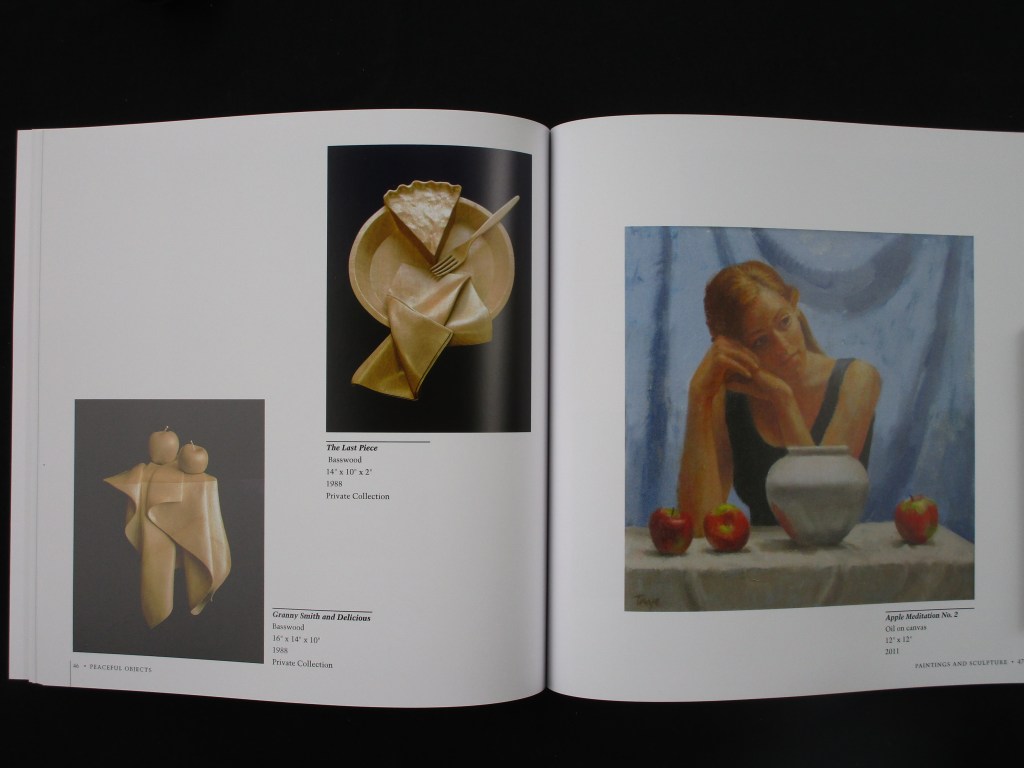
I recently decided to do a book on some of my artwork, as it has been 50 years since I finished my MFA degree. One problem I faced was what to include. I enjoy landscape, figure and still life subjects, and I make sculpture in bronze and wood. In the end, I chose to focus on still lifes, as I had a few hundred still life paintings and a few dozen wood pieces that I could consider.
The book is 80 pages, softbound, with over 90 illustrations. Several of my university colleagues helped with the design and written content, and I am quite pleased with the result.
The price is $30, and is available directly from me, or at the Capitol Contemporary Gallery in Boise. Contact me via this site if you are interested.
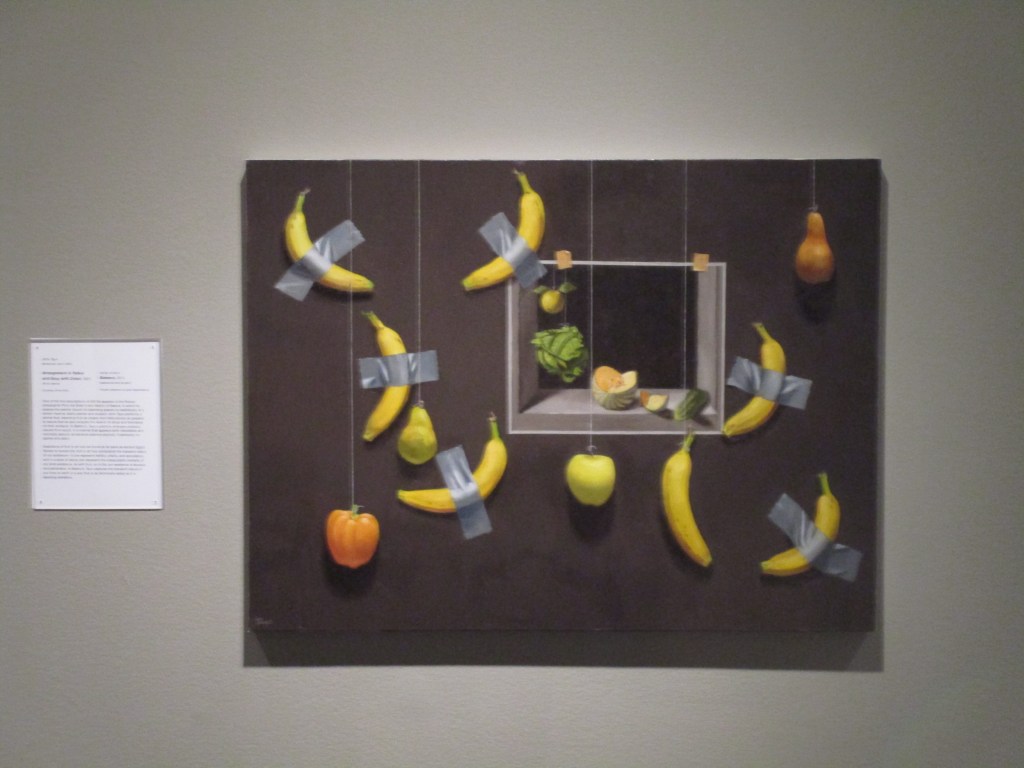
The Boise Art Museum is having a current show called, “Everyday Objects: The Enduring Appeal of Still Life”. I have two pieces in the show, the wood sculpture, “Balance”, and an oil painting, “Arrangement in Yellow and Gray, with Cotan”. Most of the work is from the Museum’s Permanent Collection, but a few pieces are on loan form local artists. The exhibit continues through September.
“The Family of Man” is on display in the 12th International Art Exhibition at the Church History Museum in Salt Lake City. This triennial show features work with religious and spiritual themes. My sculpture was done during the height of covid, and social and political unrest in 2020, and is meant to show unity and harmony. The various hardwoods represent different cultures, races, genders and ages of mankind. The exhibit continues through 2022.
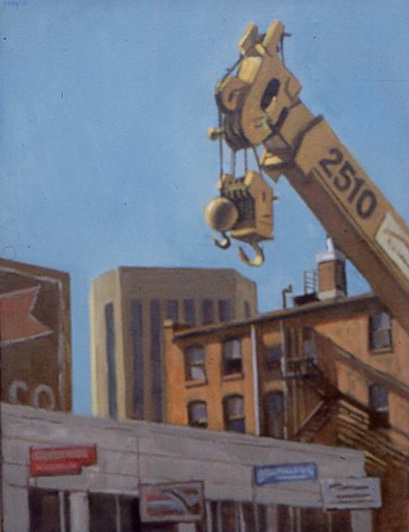
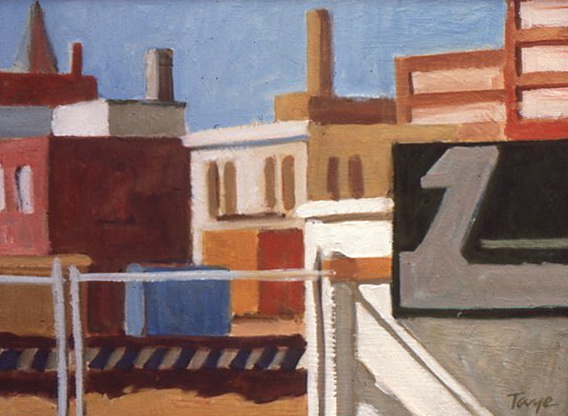
Over 40 years ago, I did a series of oil paintings of the downtown area. Urban renewal was happening, and older buildings were coming down and new ones going up. The variety of colors, shapes and architectural forms was very visually interesting. I had a show of the paintings in 1980, and since then they have been stored in my studio. I recently donated 12 of them to the city, and they are now part of the Boise Visual Chronicle Art Collection. They are currently on display in the lobby of City Hall.
I’m in a two-person show this March at the Capitol Contemporary Gallery, 451 s. Capitol Boulevard, Boise. There are a number of new oil paintings which combine still life and landscape subjects, and some new wood sculptures.
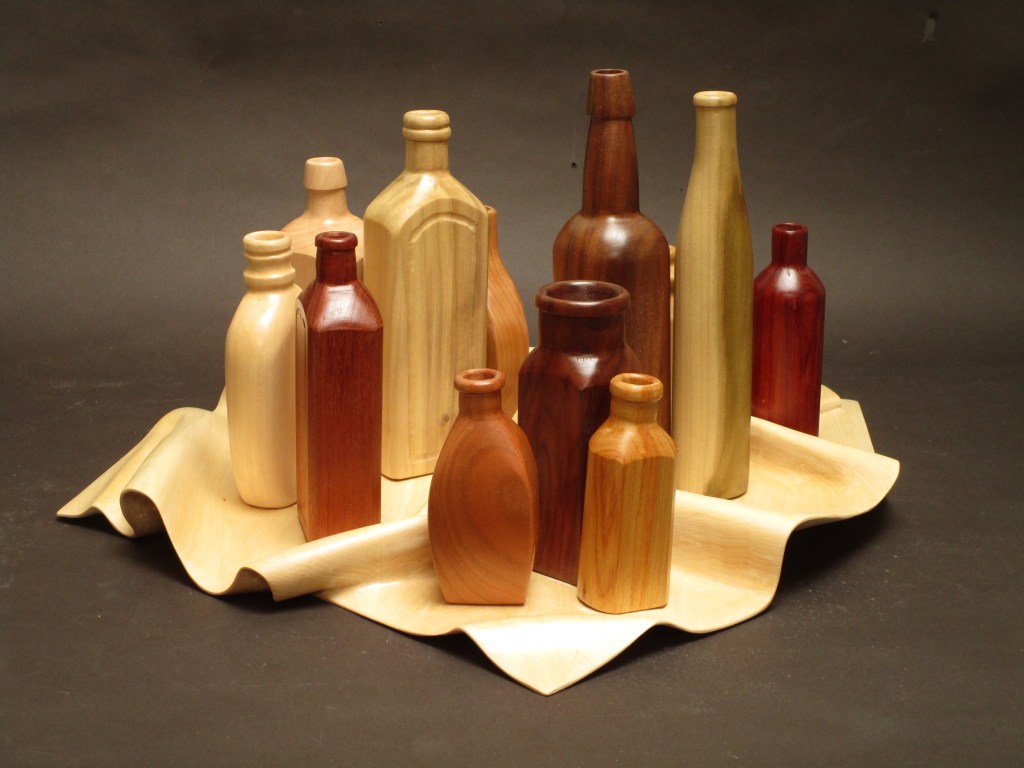
The piece shown is called, “The Human Family”, and was started in 2020, during times of social and racial unrest, wildfires burning, political divisiveness and the ever-present pandemic. I finished the piece early this year. The wood bottles represent different cultures, races, genders and ages of mankind.
From February 3-29, I’m showing new work at the Capitol Contemporary Gallery in Boise. Still life and landscape paintings will be on display, as well as wood and bronze sculptures. Pictured below is a new basswood piece, “Still Life with Pliers”.
The gallery is at 451 S. Capitol Blvd. Hours: Mon.-Fri., 10am-6pm; Sat. 10am-3pm. Parking is available on Broad Street, or in the parking garage next to the gallery entrance.
Other recent news: The drapery and pear piece in the previous post was purchased by the City of Boise, and will hang in City Hall downtown.
As you can see from my website, I really enjoy wood sculpture. The challenge of making hard wood look like soft cloth and intricate forms from nature continues to interest me. In this series, I will show how a wall sculpture (or relief) is created. My “model” is shown below–a pillowcase tacked to a soft board, with a pear hanging from a string.
I glued two basswood planks together to form a block about 27″ x 18″ x 3″ thick. After drawing the outline of the drapery on the wood, I cut out the shape on a bandsaw. The model can be seen behind.
I’ve started removing some of the wood with a gouge and wooden mallet, seen on the table.
I’m not in a hurry when working on a wood piece, as I enjoy the process. At the same time, I try to do things as efficiently as possible, which usually means using the biggest gouges that I can.
At work on the piece. The large board with the clamps on it keeps the sculpture from sliding around. I also use sandbags from time to time.
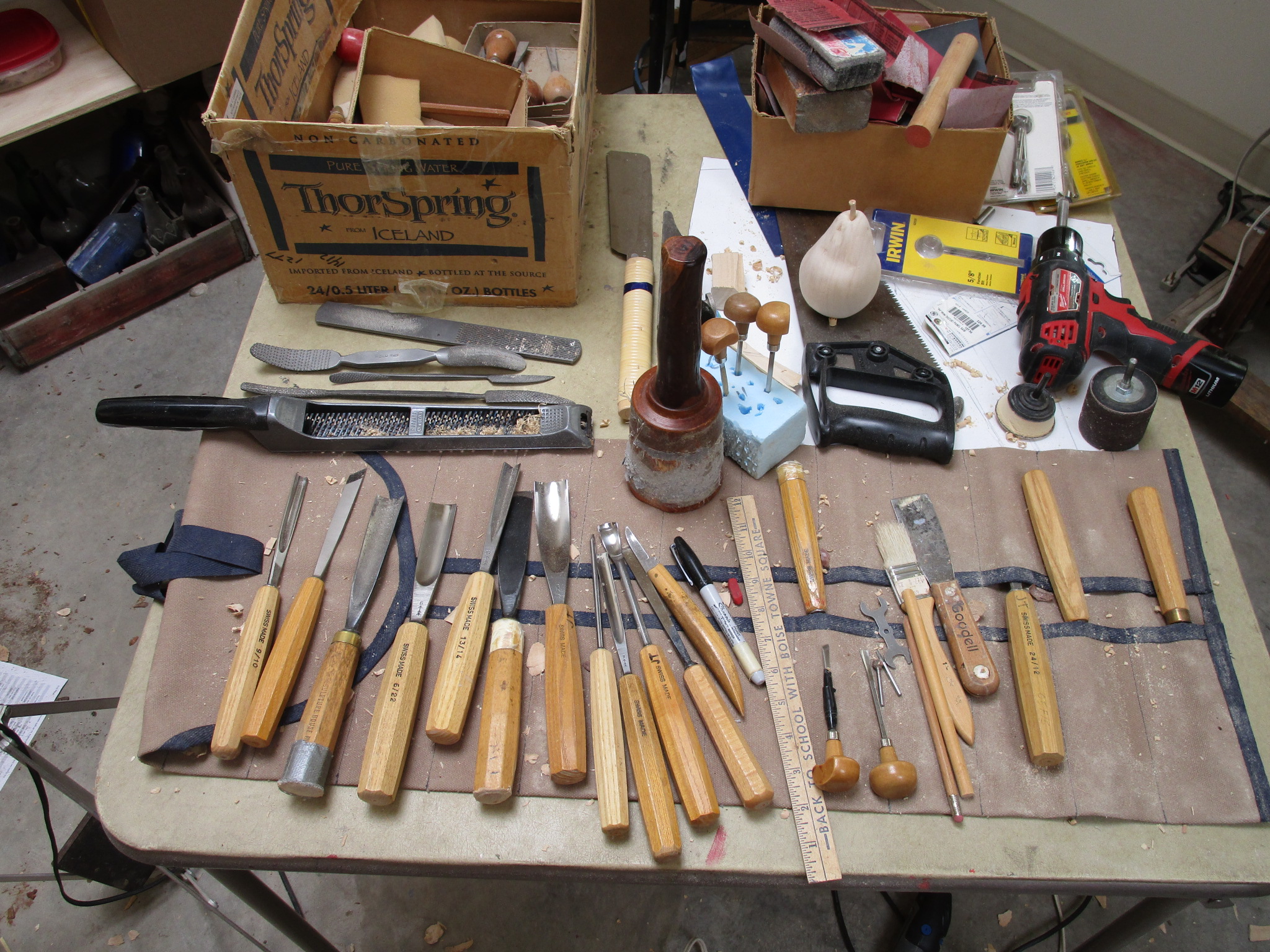
A table with an assortment of wood carving tools, rasps, etc.
The largest areas have been roughed out.
Undercuts help create the three-dimensional form of the drapery.
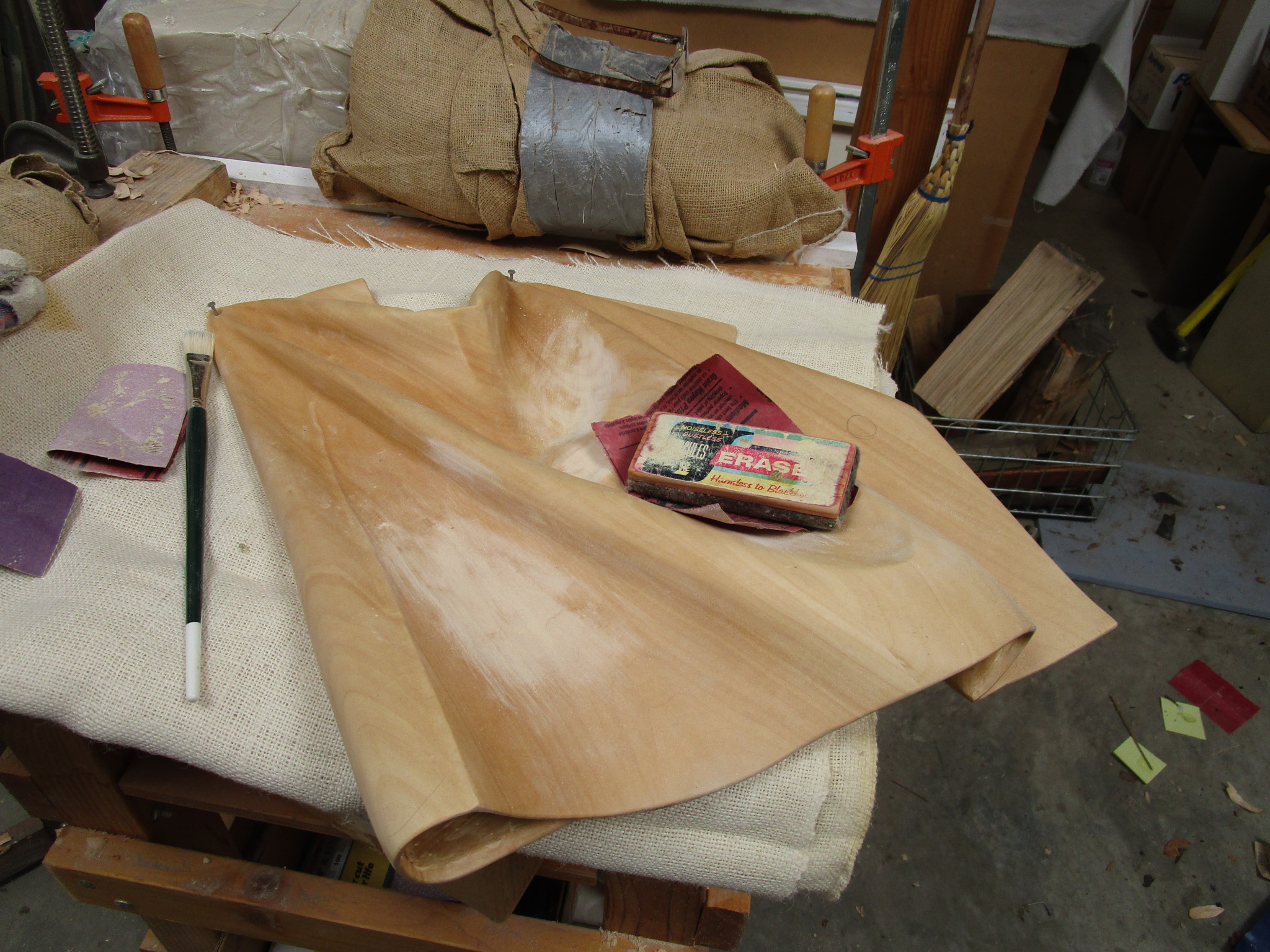
Rough sanding with 100 grit sandpaper helps to refine the surfaces. I use wood dowels of various diameters, and a soft blackboard eraser, to support the sandpaper.
Holes are drilled in the bottom to help create the undercuts there.
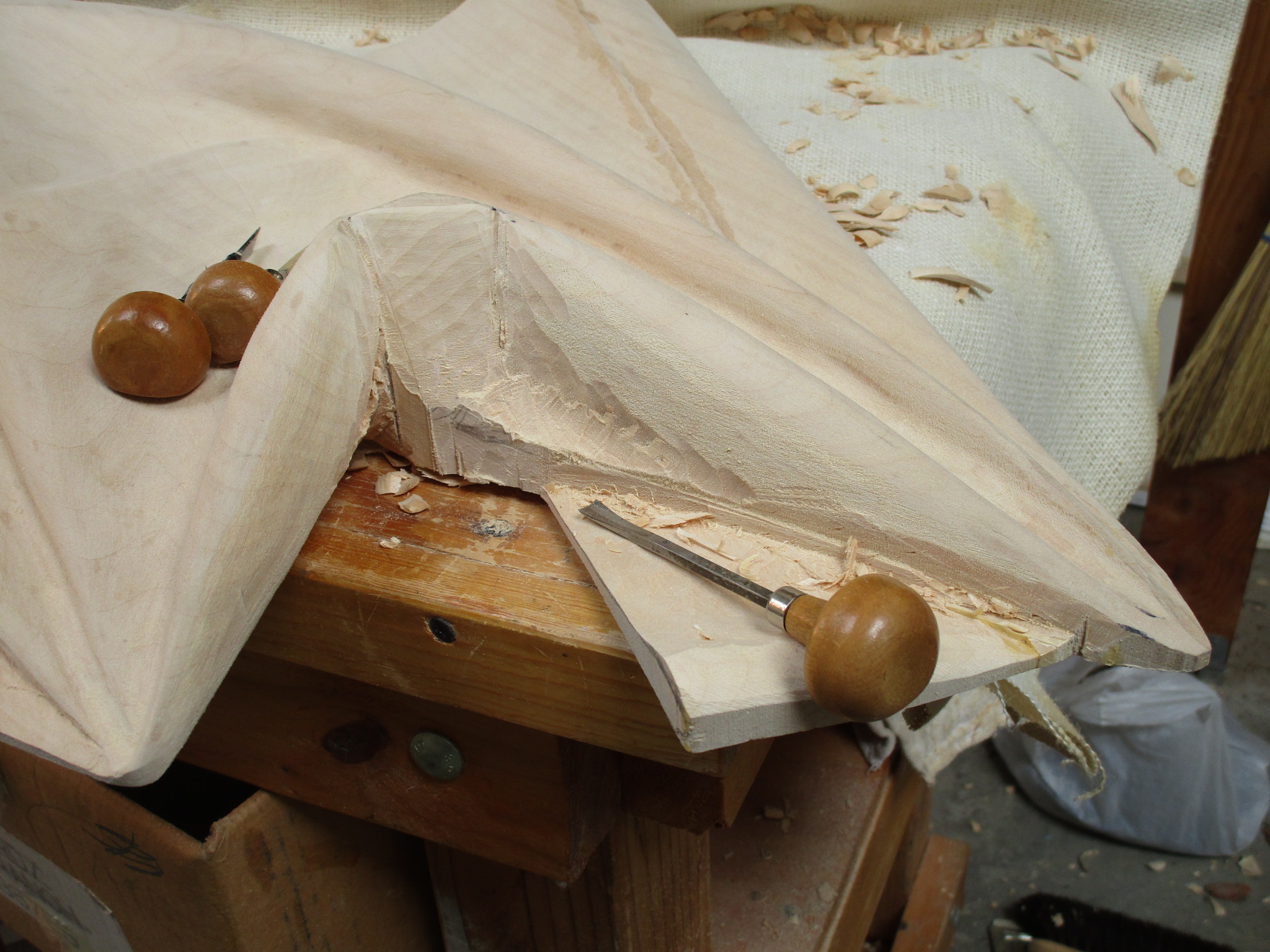
Small tools called “palm gouges” are used in detailed areas.
Ready for finish sanding. I use 100, 150, and 220 grit to create a very smooth surface.
After the first coat of clear lacquer, more sanding is needed on some areas.
.
The finished piece. The wood color and grain add their own beauty to the sculpture. The most frequent question I’m asked is, “How long did it take you to make it?” There are really two answers to that question. The short answer is about 100 hours; the second answer is that it has taken a lifetime of experience to develop my skills as an artist.



















 I’m not in a hurry when working on a wood piece, as I enjoy the process. At the same time, I try to do things as efficiently as possible, which usually means using the biggest gouges that I can.




 .
.
 John Taye Art